

Somebody always ends up in charge of the office pantry. It is rarely in the job description, and it usually happens because that person once mentioned that the coffee situation could be better. Then the water arrangement comes up, and a decision that seemed trivial turns out to involve plumbing, headcount projections and a surprising amount of admin.
Small offices sit in an awkward middle ground. A household unit is undersized for thirty people making tea at the same time, while commercial equipment built for a corporate floor is expensive and overkill for a team that fits around one table. The useful approach is to work from actual daily patterns instead of from a headcount figure alone.
Start With How the Office Actually Drinks
Total headcount is the number everyone reaches for first, and it is the least useful on its own. What determines whether a water dispenser copes is concurrency, meaning how many people want water within the same few minutes.
Arrival, the mid-morning break, immediately after lunch and the late afternoon slump generate short bursts of demand, and the rest of the day is quiet. A unit that dispenses adequately across an eight-hour average can still produce a queue at 9.15am.
Hybrid working complicates this further. A team of thirty with three days a week in the office might peak at twenty-two people on a Tuesday and eight on a Friday, and specifying for the Friday figure is a decision that gets regretted quickly.
Hot Water Is Usually the Bottleneck
Cold water dispenses quickly in most units. Hot water is where capacity limits show up, because heating takes energy and time, and a queue of people making instant coffee will empty a small hot reserve faster than it refills.
The practical checks before choosing:
- How many people make a hot drink at roughly the same time each morning
- Whether the office also runs a separate kettle or coffee machine that absorbs some of that demand
- How long the water dispenser takes to recover once the hot supply has been drawn down
- Whether adjustable temperature settings are needed for tea, coffee and instant noodles
Piped or Bottled Changes the Whole Arrangement
The single biggest structural decision is whether the dispenser connects to a water line. A piped water dispenser filters and treats water on demand from the mains, which removes the need for bottle deliveries, storage space and regular replacements.
Bottled units are more flexible on placement, since they need only a power socket. That counts for a great deal in a coworking space or a unit where plumbing work is not permitted, and it is a reasonable arrangement for very small teams.
The trade-offs become clearer at scale. Twenty people get through a considerable volume of water in a week, and the storage space for full and empty bottles is space the office is already paying rent on. A piped unit is what most water dispenser office setups settle on once headcount passes a dozen or so, largely because the bottle logistics stop justifying themselves.
The upfront cost is installation. A piped dispenser needs a plumber and access to a water point near the intended location, so the pantry layout has to be checked before committing to a model.
Filtration and What the Office Actually Notices
Filtration in an office is about taste, consistency and convenience. Hot drinks are the main use, and a team notices the difference in what they brew long before anyone reads a specification. Instant hot and cold dispensing also removes the kettle queue, the fridge jug and the standing mineral water order in one move.
What matters at the point of purchase is knowing how many filtration stages the water dispenser runs, what each stage is there for, and how often they need changing, since that is what becomes a running cost and a recurring task once the novelty wears off.
Space, Noise and the Pantry Layout
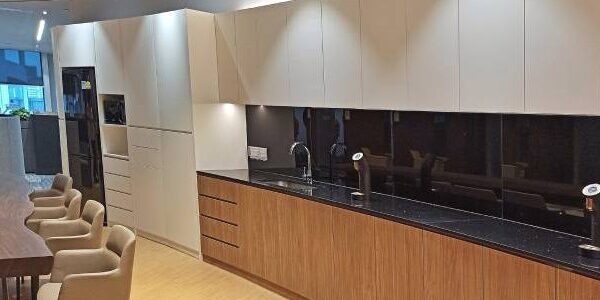
Pantry space in a Singapore office is almost always tighter than the floor plan suggests once a fridge, a microwave, and a sink have gone in. Measure the actual gap, including clearance above for a wall cabinet.
Countertop models free up floor space but take a worktop that is often already spoken for, which is where footprint differences start to matter. The Wells Mini asks for about as much room as a book or a coffee cup, and its three-way adjustable faucet lets you set the spout left, right, or centre depending on how the counter runs. The Wells Slim One takes a different route at 16cm wide, roughly a hand’s width, which is why slim formats have become popular in small offices: they sit against a wall without eating into the counter.
Noise deserves a thought if the pantry opens onto a working area, which is common in smaller offices. Compressor cycling is audible in a quiet room. The Wells TT Cooling+ is tankless and chills water as you dispense it, so it doesn’t need to keep a reservoir cold throughout the day.
Servicing and the Admin Nobody Wants
Whoever inherits the pantry roster also inherits water dispenser filter changes, and this is where office arrangements tend to fall apart. A household can absorb a forgotten filter change; an office where nobody owns the task will simply run past the interval.
Some water dispensers include an automatic self-sterilising system that handles the internal water path without manual intervention. The office water dispenser maintenance checklist covers what still needs doing locally. Before purchasing anything, establish:
- Who is responsible for filter replacement, the office or the supplier
- Whether servicing is included for a defined period and what it covers
- The expected filter cost per year, so the running figure is known upfront
- Response time if the water dispenser fails, since a non-working water dispenser is noticed within an hour
- Whether the contract scales if headcount grows or the office relocates
- What happens to the water dispenser at the end of a lease
Getting the Decision Right First Time
The questions that settle it are unglamorous. Peak concurrency, hot water recovery, plumbing access, pantry dimensions and who is in-charge of the filter change. An office that has answered those five will not choose badly.
Wells Singapore supplies both homes and corporate clients, and its range covers countertop formats. The showrooms at Wells Showroom (AZ @ Paya Lebar or 8 @ Tradehub 21) are open to anyone who would like to see the water dispensers in person, and the team can help work through what a particular pantry and headcount call for in your office space.
