

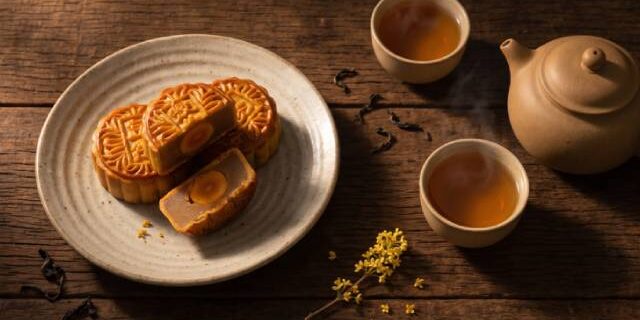
Boxes of mooncakes start appearing in office pantries weeks before anyone has worked out what to do with them. Most get taken home, and by the time Mid-Autumn arrives, there are three or four tins stacked in a cupboard with a vague plan attached to them: bring them out when relatives visit. That plan is usually as far as the thinking goes, which is a shame, because what you serve alongside a mooncake does more for the evening than the mooncake itself. The pastries are rich, dense and generous in size, and the tea poured next to them does most of the heavy lifting.
Mid-Autumn falls on 25 September, and the hosting that surrounds it tends to be informal. A pot of tea, a plate of quartered mooncakes and a table that people drift past over the course of an evening is the whole shape of it. Getting the pairing right takes very little effort once the basic logic is clear, and a hot and cold water dispenser removes most of the remaining fuss.
Why Tea and Mooncake Work Together
A traditional baked mooncake is built around lotus or red bean paste, often with a salted egg yolk at the centre, wrapped in a rich pastry. It is sweet, oily and dense enough that a small slice makes the point on its own. Tea cuts through all of that.
The reason is the astringency, which comes from the tannins in the leaves and has a cleansing effect on the palate between mouthfuls. It is a simple thing, but it explains why the pairing has stayed constant for generations while the mooncakes themselves have drifted towards snowskin, custard and chocolate variations.
That constancy is easy to see in Singapore, where tea drinking and the Mid-Autumn Festival have grown up alongside each other as parts of the same cultural life. It is part of why the pairing feels so natural at a Singaporean table, whether the gathering is a full family reunion or a few neighbours dropping in for an hour.
Matching Tea to Mooncake
The general principle is to match intensity first, and then contrast texture. Heavier, richer fillings want a tea with enough body to stand up to them, while lighter modern mooncakes are easily overwhelmed. A short guide:
- Traditional lotus paste with salted egg yolk pairs well with a roasted oolong, which has the depth to match the yolk
- Red bean paste suits pu-erh, whose earthiness balances the sweetness without competing
- Snowskin and custard mooncakes are better with a green tea or a light jasmine, since anything stronger flattens them
- Chocolate or coffee-flavoured mooncakes work with a robust black tea, which handles the bitterness
Water Temperature Does More Than People Expect
Choosing the right tea only gets you halfway. How you brew it matters just as much, and this is where most home brewing goes wrong. Tea leaves release their compounds at different rates depending on water temperature, and pouring boiling water over delicate leaves extracts the bitter fraction far too quickly.
Green tea is the clearest example. Water straight off a rolling boil scorches the leaves and produces a harsh, grassy cup that gets blamed on the tea rather than the kettle. Green tea generally prefers water somewhere in the region of 70 to 80 degrees, which means either waiting for a boiled kettle to cool or having a source that dispenses at a set temperature.
Darker leaves ask for the opposite. Oolong and pu-erh are more forgiving and reward hotter water, closer to 90 degrees, which is what opens up the roasted notes in a darker oolong. Black tea sits at the top of the range and wants the hottest water you can give it.
Managing three different temperatures from one kettle over the course of an evening is where hosting starts to feel like work: watching the kettle, waiting for it to cool, reboiling for the next pot, and then discovering someone wants cold water instead.
Where a Water Dispenser Changes the Evening
This is the practical case for on-demand temperature control in a household that entertains. Wells water dispensers offer a range of water temperature settings, including a 50 degree setting intended for baby formula and an 85 degree setting suited to hot beverages, all dispensed without a boil-and-wait cycle.
For a Mid-Autumn evening, that means topping up the teapot never involves waiting for the kettle to boil again, and a guest who would prefer chilled water is served from the same water dispenser without anyone opening the fridge. Hosting stops involving a queue at the kettle.
Serving Notes That Make a Difference
Cut mooncakes into small wedges before guests arrive. A whole mooncake is far too much for one person, and quartering or eighthing it turns an intimidating pastry into something people will actually try.
Warm the teapot with a splash of hot water before brewing, then pour it away. A cold pot drops the brewing temperature immediately, which undoes the care taken over the water in the first place.
Refill the pot rather than letting leaves sit in cooling water. Most quality leaves give three or four good infusions, and the second is often better than the first, so there is no need to open a new packet each round.
A Simple Hosting Sequence
Preparation the day before removes almost all of the effort on the night. Setting out cups, choosing which teas to serve and deciding how the mooncakes will be cut takes twenty minutes and saves considerably more.
The order that works for most households:
- Cut and plate the mooncakes an hour before guests arrive, covering them lightly
- Set out small cups, the teapot and a strainer where guests can reach them
- Start with a lighter tea early in the evening while people are still eating
- Move to a darker roasted oolong or pu-erh as the richer mooncakes come out
- Keep chilled water available throughout, since not everyone wants tea all night
- Save the strongest brew for last, once the sweet things have been cleared
Making the Evening Easy
Mid-Autumn hosting has never been about elaborate preparation. A table, something sweet, tea that people actually enjoy drinking, and guests who are happy to linger are all it really takes. Anything that cuts down the trips back to the kitchen earns its keep. At many Mid-Autumn gatherings, a pot of tea still anchors the table, even as what Singaporeans drink most has shifted over the decades.
Conclusion
Wells Singapore’s range of water dispensers is built around exactly this kind of everyday convenience, with instant hot and cold dispensing across models such as the Home Café, The One and Slim One.
Anyone weighing up options before the festive stretch is welcome at the Wells Showroom (AZ @ Paya Lebar or 8 @ Tradehub 21), where the team can talk through which water dispenser suits the kitchen and the household.
