

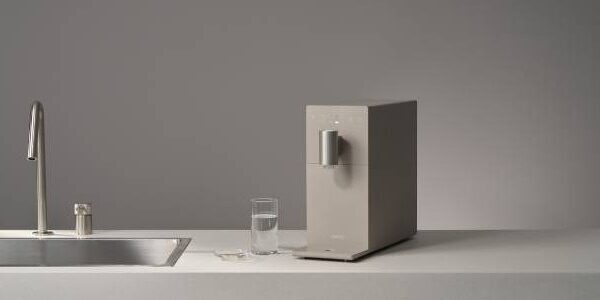
Scroll far enough down any dispenser spec sheet and the phrase turns up. Auto UV sterilisation, or automatic self-sterilisation depending on the brand, sitting quietly in a list between filtration stages and temperature settings. Almost nobody selling the water purifier stops to explain what it does.
It solves a problem most buyers have never thought to ask about. Filtration handles the water going into the water purifier, while sterilisation handles what happens to that water afterwards, in the stretch of tubing and the nozzle where it sits between one glass and the next.
The Problem That Sterilisation Solves
Filtration and sterilisation tend to get read as the same feature, and they do quite different jobs. A filter cleans what comes in. Everything past it stays untouched, which leaves the tubing and the nozzle out of the conversation entirely.
A water purifier sitting on your kitchen counter does not stay clean on its own either. Filters and internal surfaces left alone for long enough stop performing the way the spec sheet promised, which is why manufacturers pair filtration with a cleaning cycle instead of trusting the filter to carry the whole load.
That cleaning cycle matters most in the places the filter never reaches. Once treated water leaves the filter, some water may remain in the internal tubing between uses, while the nozzle is exposed to the open air every time you pour a glass. Sterilisation helps address this stretch between filter and cup, providing an additional layer of hygiene beyond the filtration stage.
How Ultraviolet Treatment Works
UV-C light scrambles the genetic material of bacteria and other micro-organisms so they can no longer reproduce. Nothing is added to the water, nothing is left behind in it, and what comes out of the nozzle tastes exactly as it did going in.
That reliability is why UV, once used mainly at public water plants, is now found in kitchen appliances. What changes from product to product is where the lamp sits along the water path, how much of the system its light reaches, how often the cycle runs, and whether the household has to remember to start it.
Why the Word Automatic Carries the Weight
A manual cycle depends on somebody running it. In practice, that means a button pressed diligently for the first month and then quietly forgotten, in much the same way descaling the kettle slides down the list until the kettle starts complaining.
Automatic self-sterilisation takes the decision away from you. The water purifier runs its own cycle on a schedule, treating the internal water path and the nozzle while nobody is paying attention. For an appliance a family reaches for a dozen times a day, usually in a hurry, that is the entire point of the feature.
A modern water purifier that handles this quietly in the background is doing something a jug filter or an unfiltered tap cannot. Every Wells water dispenser comes with 9-step nanofiltration and a tankless design. All models apart from the Wells Mini also include an automatic self-sterilising system, so less of the upkeep lands on the household. What to check on any water purifier you are comparing:
- Whether the sterilisation cycle is automatic or has to be started manually
- Which parts of the water path the cycle actually covers, including the nozzle
- How often the cycle runs, and whether it can be scheduled around household use
- Whether the water purifier is tankless, since a stored tank holds standing water for longer
- What the manufacturer specifies for filter replacement intervals
The Part Still Left to You
Whatever the water dispenser does inside itself, the outside stays your job. Drip trays collect spills, and the area around the nozzle picks up fingerprints the way every other appliance handle in the kitchen does.
How you clean it makes a difference, since abrasive cleaners and harsh chemicals strip finishes. Sanitising a water dispenser correctly comes down to mild soap and a soft cloth used often, rather than the occasional aggressive scrub.
Servicing is the last piece. Most households do well to book a technician periodically no matter how much the water dispenser handles on its own, because a technician can spot wear and faults inside the machine that an automatic cycle cannot.
Reading a Spec Sheet Properly
Feature lists blur into marketing language quickly, and pulling the substantive claims out of the decorative ones takes a minute. Filtration stages, temperature options, sterilisation method, and tank design are the four that shape what daily life with the water purifier feels like.
Wells The One water dispenser, for instance, is specified with 9-step nanofiltration and a spread of temperature settings, including 50 degrees for baby formula, 70 degrees for tea and 85 degrees for coffee. Being tankless, it chills water on demand instead of holding a reservoir of it. Questions to ask before you buy:
- How many filtration stages are included, and what does each stage remove
- Should it be tankless or tank-based
- What temperature presets are available, and are they adjustable
- Is sterilisation automatic, and what does it cover
- What is the expected filter replacement interval and cost
- What does servicing involve, and is it included for any period
Choosing With the Full Picture
Auto UV sterilisation rarely decides a purchase on its own, though dismissing it as marketing garnish would be a mistake too. Think of it as one piece of a design meant to reduce how often you have to think about an appliance you use several times an hour.
Where it earns its place is in the gap between what buyers imagine and what really happens over five or six years of ownership. A water dispenser looking after its own internal water path is simply easier to live with than one waiting for somebody to remember.
Wells Singapore’s water dispenser range, from the compact Mini and Slim One up to The One, Ice One, Home Café, and TT Cooling+, is built around that idea. The Wells Showroom (AZ @ Paya Lebar or 8 @ Tradehub 21) are open to anyone who would rather see the water dispensers in person and have the specifications walked through before deciding.
